



Dr. Laura Hooton Talk

Tuesday, November 17, 2026
Dr. Laura Hooton will give a talk on her most recent book, Little Liberia: A Dream of Black Freedom in the US-Mexico Borderlands.
Her lecture will begin at 2:00 pm in the Hi…
The Department of Africana Studies at the University of New Mexico is an interdisciplinary major degree-granting department, which provides students with a broad understanding of the political, social, and historic linkages between peoples of Africa and other African-descended people in the Southwest, the rest of the United States, and throughout the Black Diaspora in Mexico, Latin America, Europe, and the Caribbean. Black diasporic methodologies are essential to unpacking the role that the Black Diaspora plays in global cultural, revolutionary, and technological advances. Global South Studies, Afrofuturism and Afropessimism, Transgender Studies, Transnational Intersectional Feminisms are but a few of the remarkably broad range of academic and research interests and social justice imperatives that Africana Studies applies that are central to the overarching research mission of the University of New Mexico.
OUR MOTTO
LIFTING AS WE CLIMB
OUR MISSION
Giving students of all races, ethnicities, and backgrounds a full understanding of the global linkages between peoples of Africa and other African descended people in the Southwest, the contiguous United States and throughout the Black diaspora.
Tuesday, November 17, 2026
Dr. Laura Hooton will give a talk on her most recent book, Little Liberia: A Dream of Black Freedom in the US-Mexico Borderlands.
Her lecture will begin at 2:00 pm in the Hi…
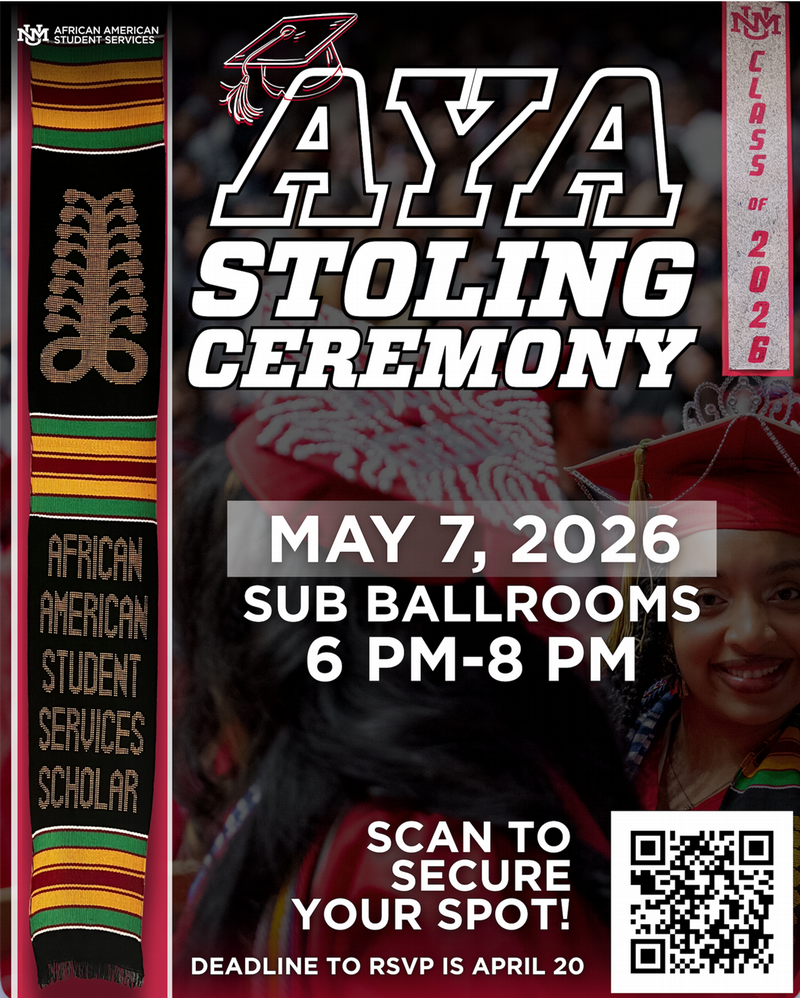
Congratulations to our amazing graduates! Aya Stoling Ceremony May 7th in the SUB Ballrooms
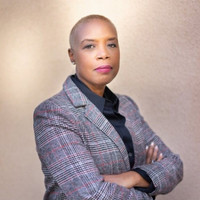
Africana Studies faculty member Dr. Andrea Mays was recently interviewed for the Black Studies Podcast:

© The University of New Mexico
Albuquerque, NM 87131, (505) 277-0111
New Mexico's Flagship University